

How cochlear implants restore hearing
A clear explanation of what a cochlear implant is, how it works, and what to expect on the journey to new sound.
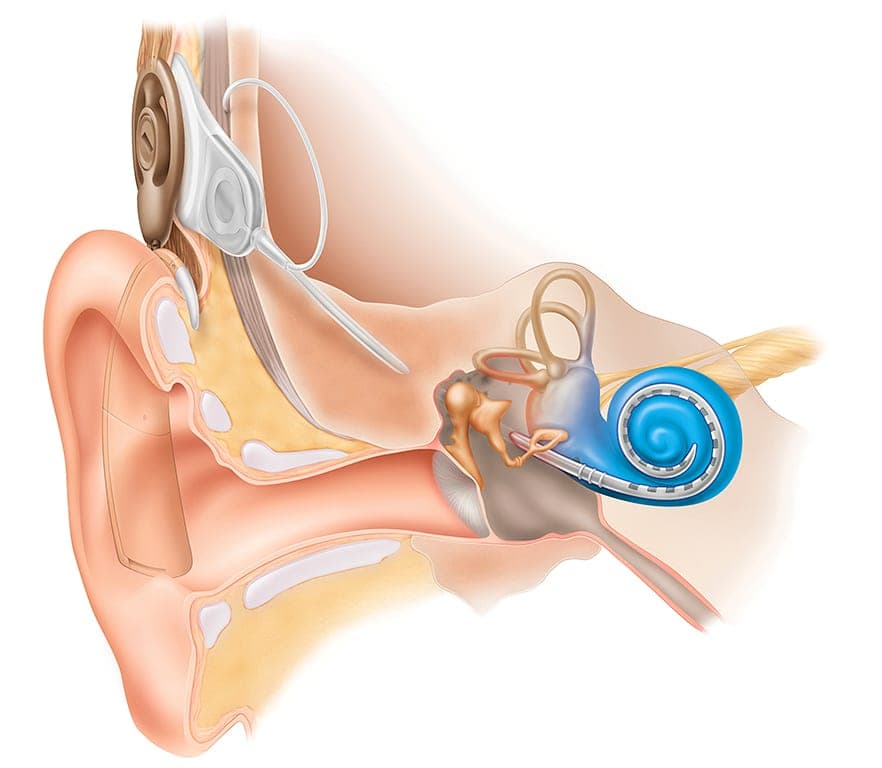 How the implant works
What is a cochlear implant?
A cochlear implant is a medical electronic device that helps people hear when they have severe to profound sensorineural hearing loss and hearing aids no longer make speech clear.
Unlike a hearing aid, which amplifies sound, a cochlear implant bypasses the damaged parts of the inner ear and directly stimulates the hearing nerve.
The system has two parts: an external sound processor and an internal implant placed during a short operation. Together they deliver sound information to the brain.
The decision to implant is made by a team of specialists after a full assessment.
How hearing works
Sound travels a long path — from an air wave to a signal the brain understands.
Outer ear
The pinna collects sound waves and channels them down the ear canal to the eardrum.
Middle ear
The eardrum vibrates and passes the vibrations through three tiny hearing bones.
Cochlea
In the inner ear, the hair cells of the cochlea turn vibrations into nerve impulses.
Hearing nerve
Impulses travel along the hearing nerve to the brain, where they are recognised as sound and speech.
How the implant works
The cochlear system takes over the job of the damaged hair cells.
01 · Sound processor
Microphones pick up sound and turn it into a digital code.
The signal travels the whole path in a fraction of a second.
- Sound processor. Microphones pick up sound and turn it into a digital code.
- Transmitting coil. Sends the code through the skin to the implant using a magnet.
- Implant. Receives the signal and converts it into electrical impulses.
- Electrodes in the cochlea. Stimulate the hearing nerve directly, bypassing the damaged cells.
External part
Sound processor
Microphones pick up sounds and convert them into a digital code.
Transmitting coil
Sends the coded signal through the skin to the implant using a magnet.
Internal part
Implant
Receives the signal and converts it into electrical impulses.
Electrode array
Stimulates the hearing nerve inside the cochlea, bypassing the damaged cells.
What changes with an implant
A cochlear implant restores access to the world of sound and real conversation.
Clear speech
Understand conversation again — even in noisy places.
Phone & video calls
Talk freely with loved ones at any distance.
Music & everyday sounds
Hear music, nature and the sounds of the city again.
Speech development in children
Early implantation supports speech and learning.
Hearing with both ears
Tell more easily where a sound is coming from.
Confidence & safety
Hear alerts, traffic and everything around you.
Who can be a candidate
Candidacy is always determined individually by a team of specialists. Below are general guides.
Adults
- Severe or profound hearing loss in both ears
- Hearing aids provide limited benefit
- Willingness and motivation for rehabilitation
- No medical contraindications
Children
- Congenital or early severe hearing loss
- The earlier the implant, the better speech develops
- Family support and speech-therapy sessions
- Regular follow-up and processor tuning
The journey to new sound
We support you at every step — from your first consultation to confident hearing.
- 1
Assessment
Audiological and medical evaluation to determine whether an implant is suitable.
- 2
Surgery
An experienced surgeon performs the implantation — usually a short procedure with a quick recovery.
- 3
Activation
A few weeks later, an audiologist switches on and tunes the sound processor.
- 4
Rehabilitation
Sessions help the brain learn to recognise new sounds and speech.
Frequently asked questions
Still have questions about implants?
Book a free consultation — we’ll explain in detail and help you understand.
Book a consultation